A bowing or leaning foundation wall is under serious pressure and won't fix itself. We stabilize and straighten failing walls with engineered carbon fiber and wall anchor systems.
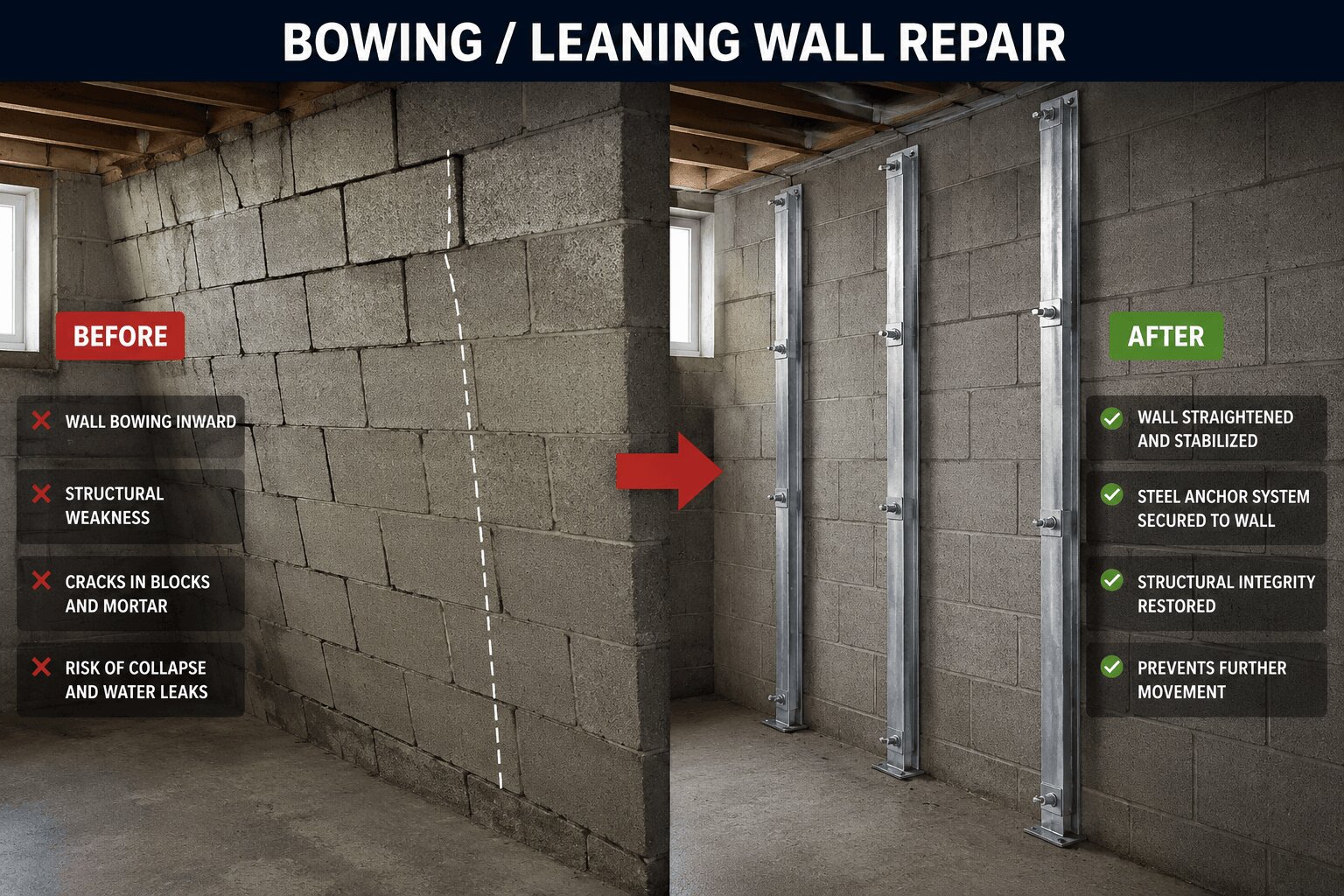 🏗️Photo: Bowing wall reinforcement in Rock Hill, SCReplace this file with your photo — keep the same filename
A foundation wall that bows inward, leans, or buckles is one of the clearest signs of a structural emergency in the making. It happens when the soil outside your foundation exerts more lateral pressure than the wall was built to withstand. In the Rock Hill area, this pressure builds when our clay-heavy soils absorb water and expand, pushing relentlessly against basement and crawl space walls. Add poor drainage, hydrostatic water pressure, or tree roots, and even a well-built wall can begin to give way. Once a wall starts to bow, the movement accelerates — and a wall that fails completely can require full replacement at enormous cost.
The good news: caught in time, a bowing wall can almost always be stabilized — and often straightened — without tearing it out. Our specialists measure the degree of deflection, identify the source of the pressure, and design a reinforcement system engineered for your specific wall. We'll show you exactly how far the wall has moved and explain your options in plain language, so you can make a confident decision.
For walls with mild to moderate bowing, carbon fiber straps are an exceptionally strong, low-profile solution. These straps are bonded vertically to the wall with industrial epoxy and anchored to the floor and sill. Carbon fiber has a higher tensile strength than steel, yet sits nearly flush against the wall — so it can be painted over and won't intrude into your space. Once installed, it locks the wall in place and prevents any further inward movement.
For walls with more significant bowing or active movement, we install wall anchor systems. Steel anchors are placed in stable soil away from the foundation and connected to a wall plate by a rod running through the wall. Tightening the anchors halts the movement immediately and, over time, can actually pull the wall back toward straight. Wall anchors are ideal where there's room in the yard to set the anchor and where the wall needs active correction, not just bracing.
Straightening a wall without fixing what pushed it in is only half a repair. That's why our recommendations often pair wall reinforcement with drainage and waterproofing improvements that relieve the hydrostatic pressure behind the wall. By controlling the water and soil pressure at the source, we make sure the wall stays put for good.
Understanding the cause helps explain why this problem is so common locally. The clay soils around Rock Hill are highly expansive, meaning they absorb water and swell dramatically after rain, then shrink and pull away as they dry. Each cycle pushes against your foundation walls and then releases, working them loose over years. Poor grading that directs water toward the house, clogged or missing gutters, and saturated soil after storms all multiply that lateral pressure. Frost and the weight of saturated backfill add even more force. A wall built to resist normal soil loads simply wasn't designed for the repeated, concentrated pressure these conditions create — which is why proactive reinforcement and drainage are so important.
A bowing wall never improves on its own — it only gets worse, and the cost only climbs. If your basement or crawl space walls are cracking horizontally, leaning, or visibly curved, call (803) 990-3003 today for a free inspection. We'll tell you how serious it is and exactly how to fix it.
Tell us what you're seeing and we'll schedule a free, no-obligation inspection — usually the same week. Prefer to talk now? Call or text (803) 990-3003.
Catch it early and save thousands. Call now for your free inspection.
📞 (803) 990-3003